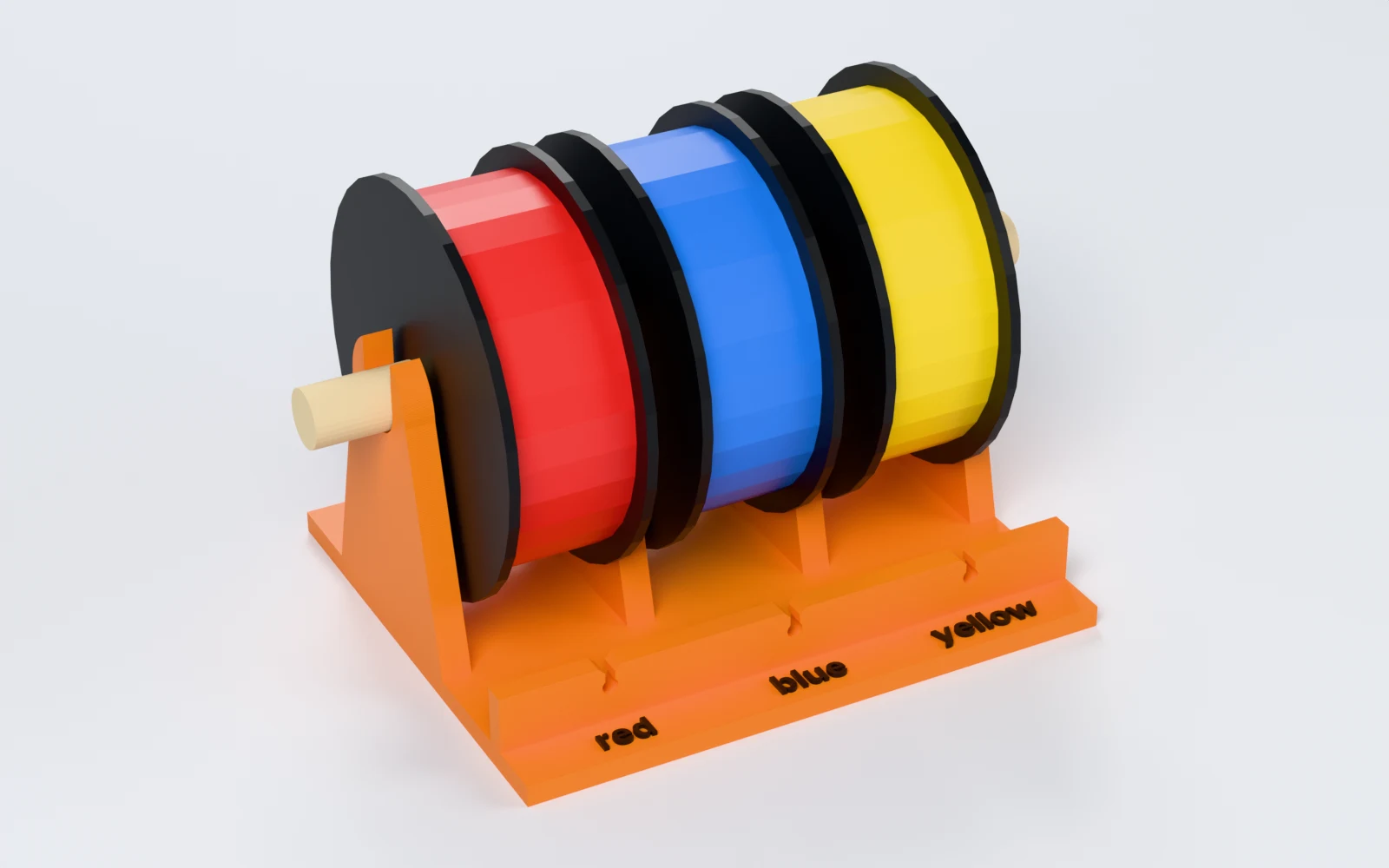
What can you make with Wire Spool Holder Generator?
Caddies for 1 to 12 spools of up to three kinds, or brackets for a rod of any length. Makers print:
- A caddy for six spools of hook-up wire.
- A solder reel screwed to the bench.
- Wire on the wall above the bench.
- Brackets for big spools on a threaded rod.
How do you make a wire spool holder, step by step?
Everything is in the panel beside the holder, which updates as you change it. Start from a preset, then change what you need.
1. Start from a preset
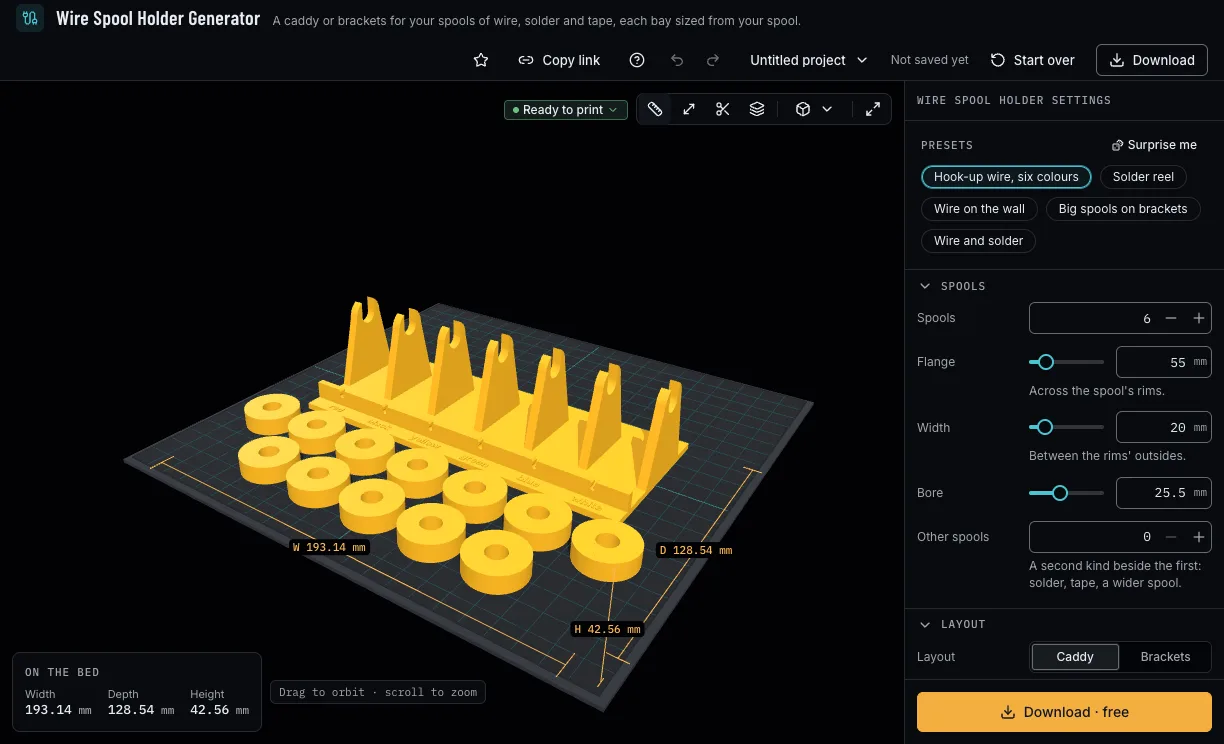
Pick Hook-up wire, Solder reel, Wire on the wall, Big spools on brackets or Wire and solder. A preset sets only what it names; Surprise me tries another clearance and keeps your spools.
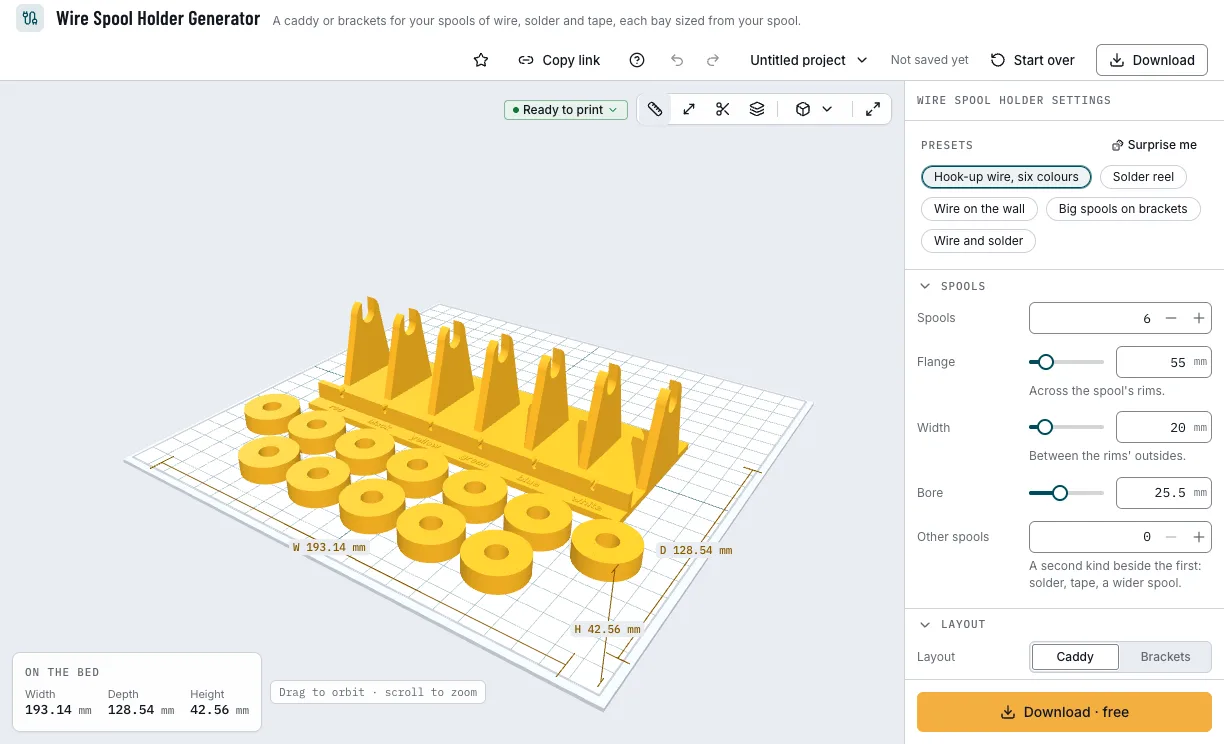
The presets and the caddy they make. 2. List your spools
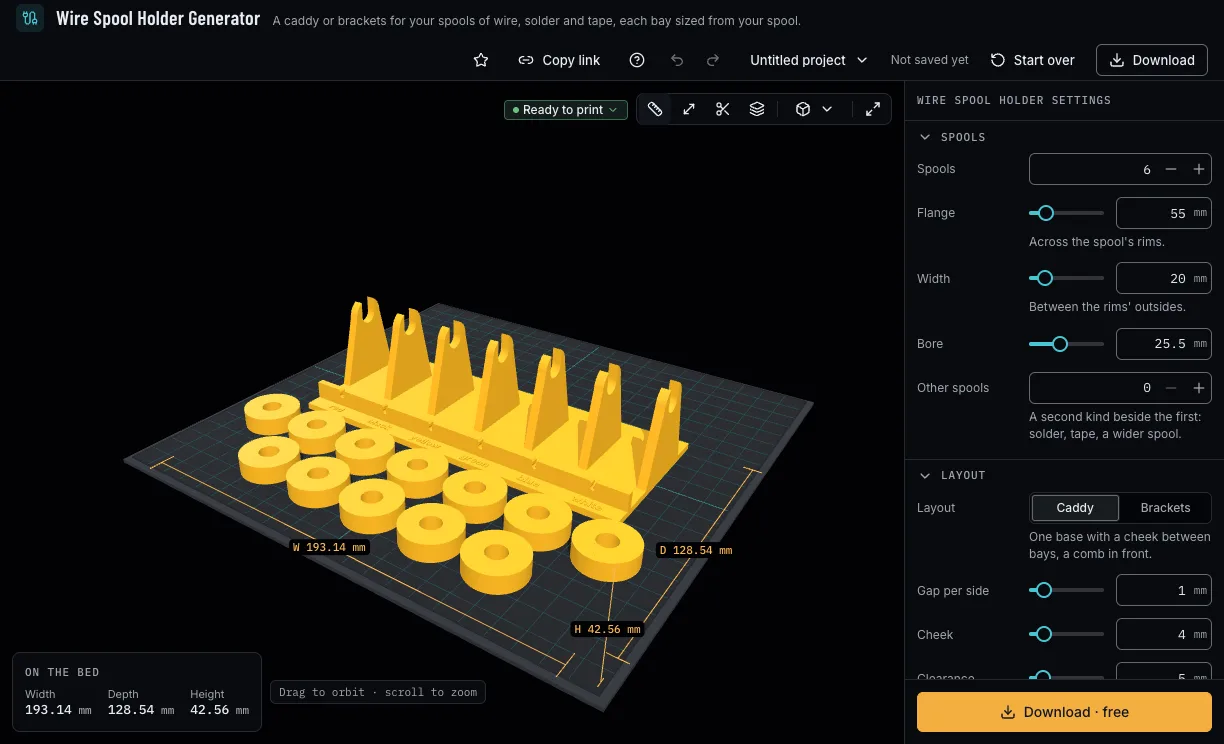
Measure a spool across its rims (the flange), between the rims' outsides (the width) and its hole (the bore), and say how many. Add a second or third kind beside the first: solder, tape, a wider spool.
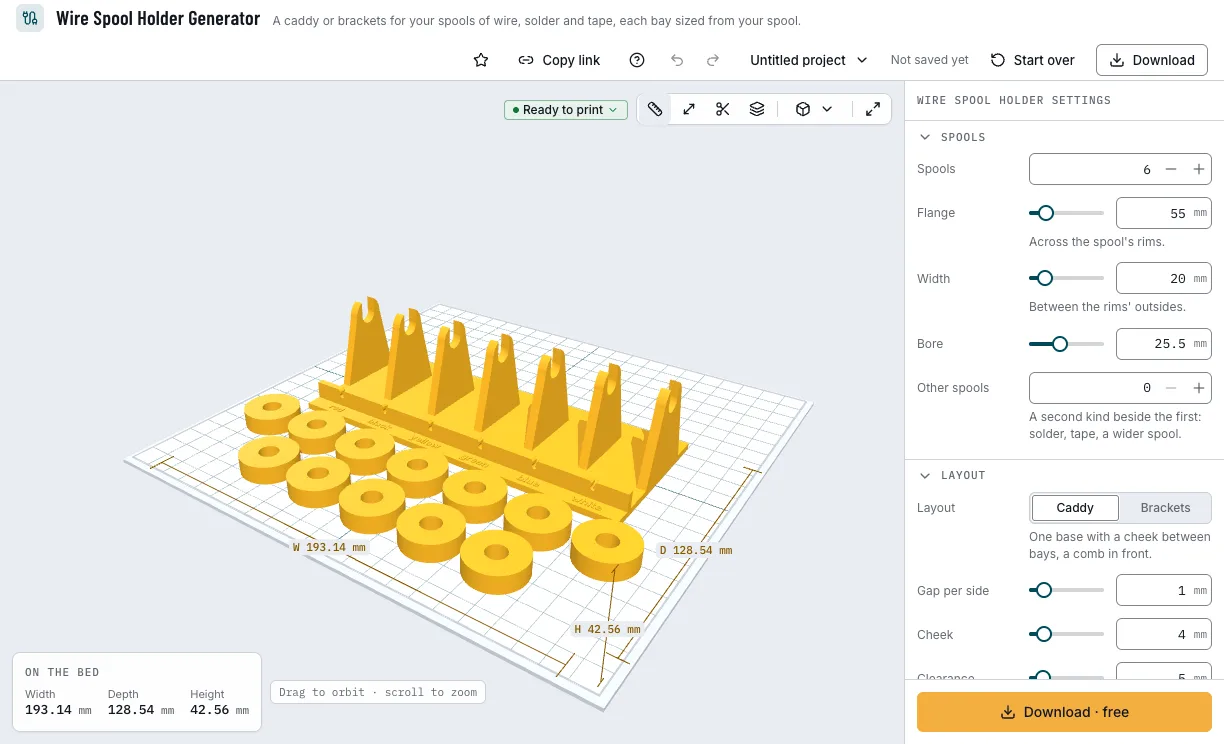
Six spools, 55 × 20 mm on a 25.5 mm bore. 3. Pick the rod
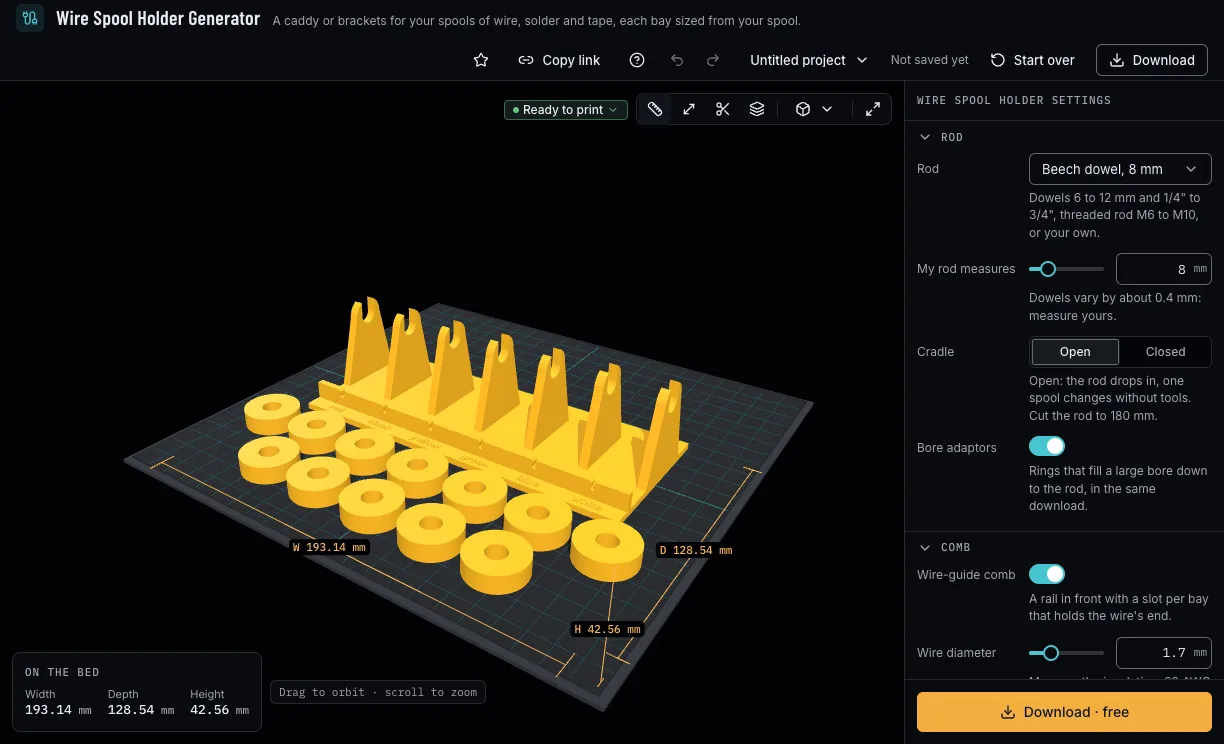
Choose a dowel or a threaded rod that passes every bore, then type what yours measures: dowels vary. Open cradles let the rod drop in; closed ones hold it for a holder that travels. Adaptors fill large bores down to the rod.
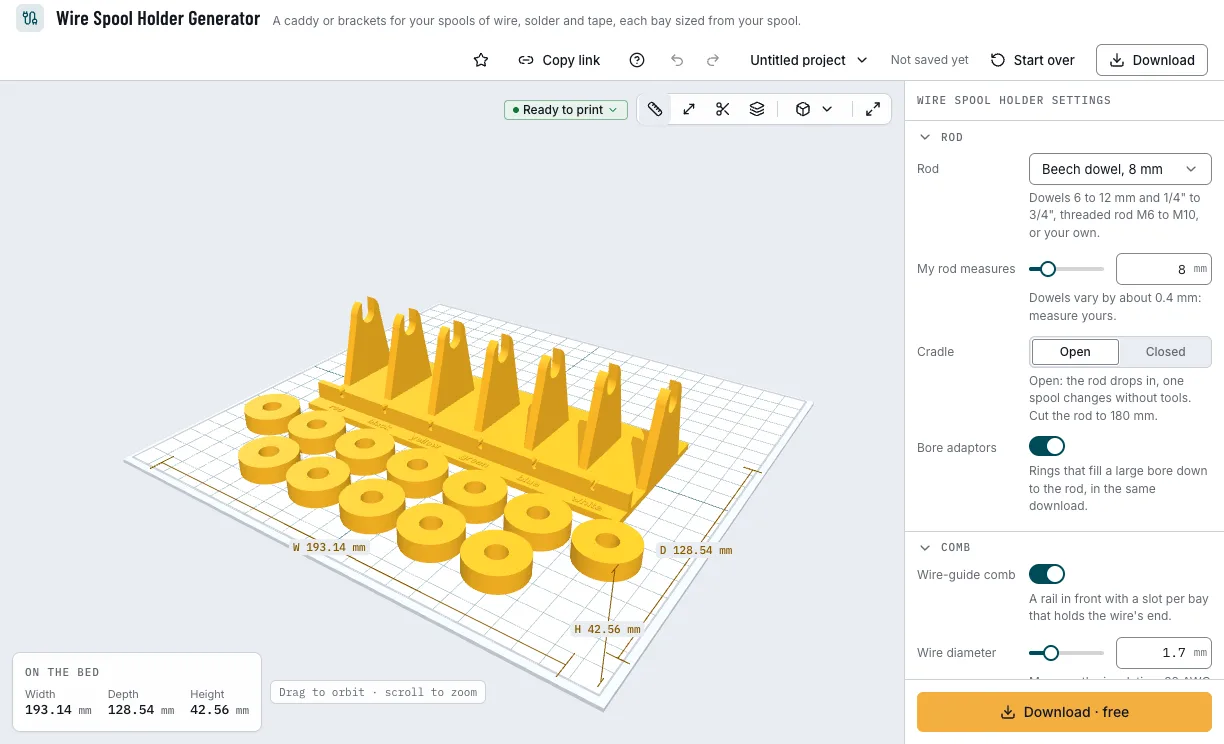
An 8 mm beech dowel in open cradles. 4. Set the comb
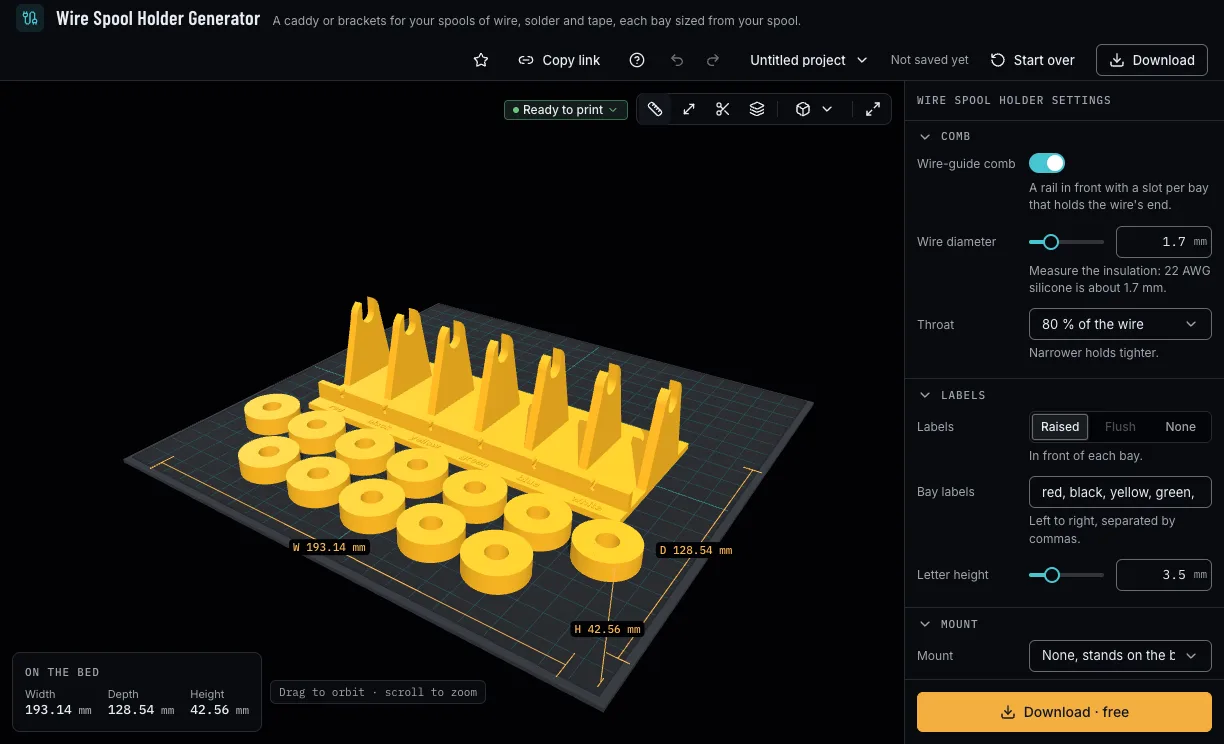
Measure your wire's insulation and type it: each bay gets a slot in the rail in front that narrows to a throat. Push the end through and it stays.
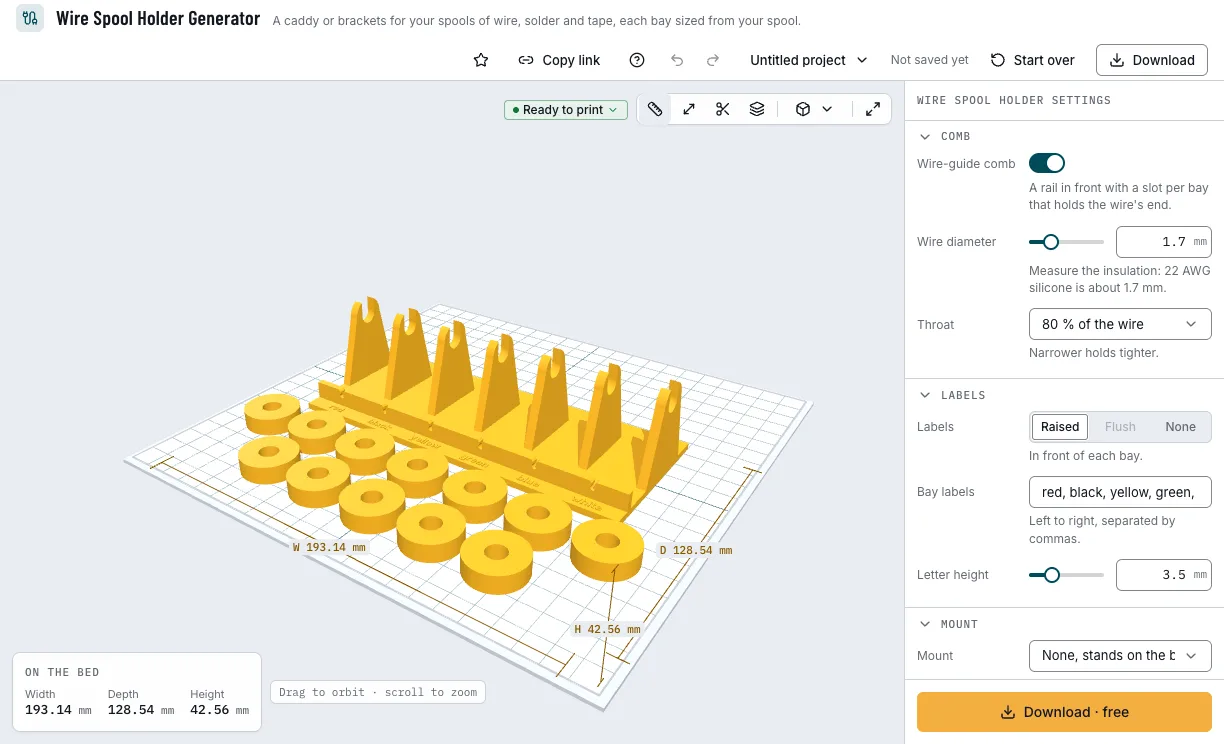
A 1.7 mm wire behind an 80 % throat. 5. Check it and download
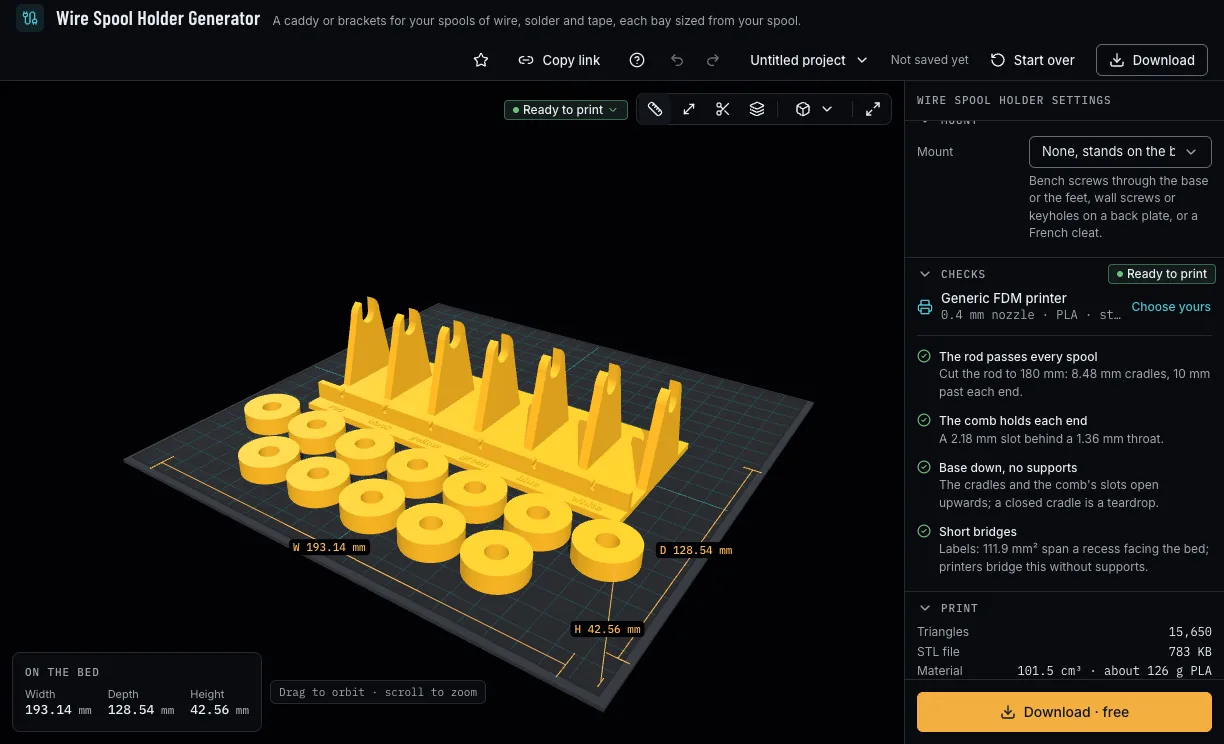
The checks say whether the rod passes every spool and how long to cut it, whether the comb prints and how it fits your bed. Then download 3MF or STL.
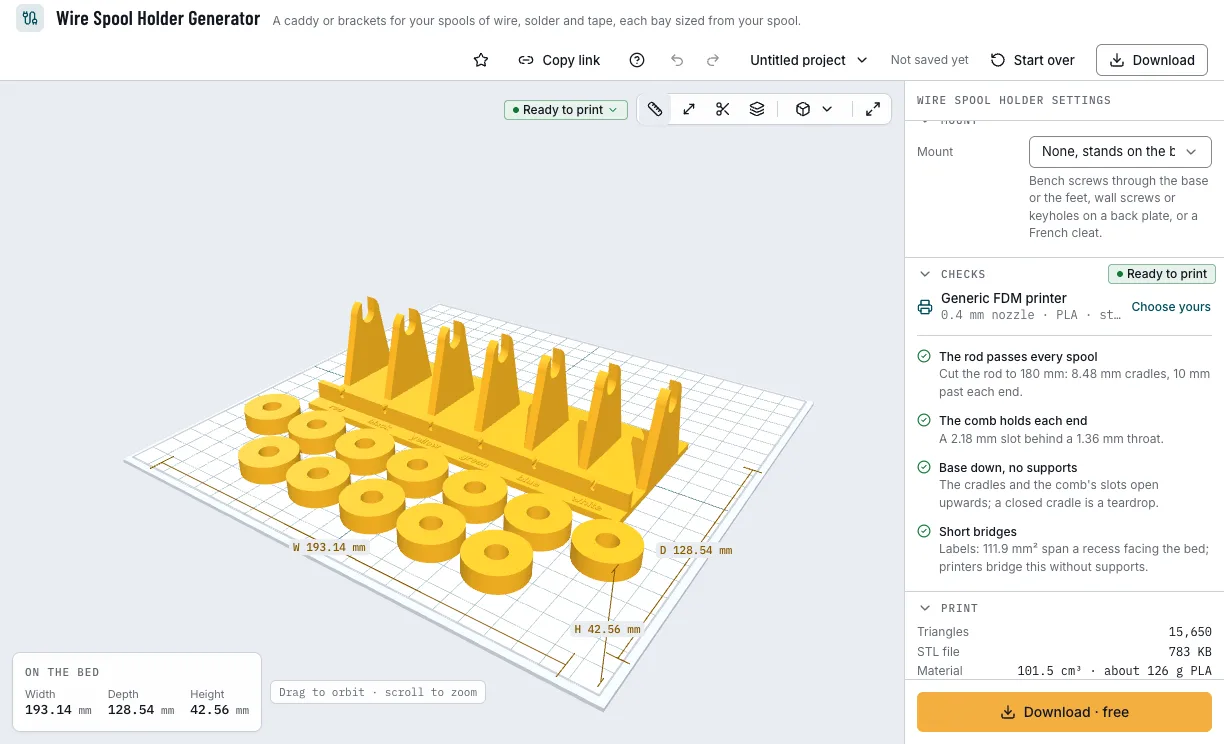
The checks and the download.
Which spool holders can you start from?
Each example opens in Wire Spool Holder Generator as a new design, beside your own.
Hook-up wire, six colours
Six spools of hook-up wire, a comb and a label each.
- 6 spools
- 8 mm dowel
- Adaptors
- Free
Solder reel
One solder reel screwed to the bench.
- 1 reel
- 12 mm dowel
- Bench screws
- Free
Wire on the wall
Four spools on the wall above the bench.
- 4 spools
- 8 mm dowel
- Wall screws
- Free
Big spools on brackets
Two big spools on brackets and a threaded rod.
- 2 brackets
- M10 rod
- Bench screws
- Free
Which print settings work best for a wire spool holder?
A caddy prints base down: its cradles and the comb's slots open upwards, so no supports are needed. Brackets print on their side, the rod's weight along the layers.
| Filament | Layer height to start | Thinnest wall | Supports | Notes |
|---|---|---|---|---|
| PETG | 0.2 mm | 0.8 mm | None | Keeps its shape next to a soldering iron. |
| PLA | 0.2 mm | 0.8 mm | None | Fine for hook-up wire, away from the iron. |
Tips for a holder that dispenses well
- Measure your rod and type it in: a dowel can be 0.4 mm off its size.
- Measure a spool's width over its rims, not the wire.
- Print the adaptors with the holder, a pair per spool with a large bore.
- Screw a solder reel's holder down: a heavy reel tips a light stand.
- Before you print, check it on the view's bar: Dimensions shows its size, Measure the distance between two points, Section cuts it open and Layers steps through it as your printer will.
What if the rod will not go in, or a wire slips out?
- The rod is tight in the cradles
- Type what your rod really measures, or run the Fit Test so the cradles take your printer's fit.
- The checks say the rod does not pass a spool
- Press Apply for the thickest rod of the table that passes every bore.
- A wire slips out of the comb
- Measure the insulation again and pick a narrower throat.
- The caddy is longer than the bed
- Leave Split to fit the bed on: it comes in modules of whole bays, the rod joins them.
Is Wire Spool Holder Generator free?
Yes. Every layout, rod and download is free; downloading needs a free NabiMakes account, which also keeps your projects.
Free
Free- Caddies and brackets
- Rods from the table, or measured
- Bore adaptors and the comb
- 3MF and STL
Every setting, with its range and default
Lengths are in millimetres. Each setting shows only where it applies: the comb and the labels for a caddy, the brackets' count for brackets.
| Setting | Range | Default | What it does |
|---|---|---|---|
| Spools | |||
| Spools | 1–12 | 6 | How many spools of the first kind. |
| Flange | 20–250 mm | 55 mm | Across the spool's rims. |
| Width | 5–120 mm | 20 mm | Between the rims' outsides. |
| Bore | 4–60 mm | 25.5 mm | The spool's hole. |
| Other spools | 0–12 | 0 | A second kind beside the first; 0 for none. |
| Flange | 20–250 mm | 80 mm | The second kind's flange. |
| Width | 5–120 mm | 64 mm | The second kind's width. |
| Bore | 4–60 mm | 14 mm | The second kind's bore. |
| A third kind | 0–12 | 0 | A third kind; 0 for none. |
| Flange | 20–250 mm | 64 mm | The third kind's flange. |
| Width | 5–120 mm | 24 mm | The third kind's width. |
| Bore | 4–60 mm | 20 mm | The third kind's bore. |
| Layout | |||
| Layout | Caddy, Brackets | Caddy | A caddy, or brackets for a rod of any length. |
| Brackets | 2–6 | 2 | How many brackets: two ends and middle ones. |
| Gap per side | 0.5–5 mm | 1 mm | Beside each spool, on each side. |
| Cheek | 3–12 mm | 4 mm | The cheeks' thickness. |
| Clearance | 2–30 mm | 5 mm | Under the largest flange. |
| Split to fit the bed | On, off | On | Modules of whole bays that fit your bed. |
| Rod | |||
| Rod | 14 options | Beech dowel, 8 mm | A dowel or a threaded rod from the table, or your own. |
| My rod measures | 3–30 mm | 8 mm | What your rod measures. |
| Cradle | Open, Closed | Open | Open, the rod drops in; closed, it slides through. |
| Bore adaptors | On, off | On | Rings that fill a large bore down to the rod. |
| Comb | |||
| Wire-guide comb | On, off | On | A rail in front with a slot per bay. |
| Wire diameter | 0.3–6 mm | 1.7 mm | The wire's outside diameter. |
| Throat | 60 % of the wire, 70 % of the wire, 80 % of the wire, 90 % of the wire, 100 % of the wire | 80 % of the wire | How narrow the slot's throat is, of the wire. |
| Labels | |||
| Labels | Raised, Flush, None | Raised | Raised, flush or none. |
| Bay labels | Up to 400 characters | red, black, yellow, green, blue, white | One per bay, left to right. |
| Letter height | 2–8 mm | 3.5 mm | The letters' height. |
| Mount | |||
| Mount | None, stands on the bench, Screws, French cleat | None, stands on the bench | None, screws or a French cleat. |
| Screws into | Bench, Wall | Bench | Into the bench, or the wall on a back plate. |
| Hole | Straight, Keyhole | Straight | Straight holes or keyholes. |
| Screw | 27 options | 4 mm wood screw · countersunk | The screw, from the hardware tables or your own. |
| Head | Countersunk 90°, Countersunk 82° (inch), Pan or round | Countersunk 90° | Your own screw's head. |
| Shank | 1.5–10 mm | 4 mm | Your own screw's shank. |
| Head diameter | 2–20 mm | 8 mm | Your own screw's head diameter. |
| Head height | 0.5–10 mm | 2.5 mm | Your own screw's head height. |
| Holes | 1–6 | 2 | How many wall screws. |
| Angle | 45°, 30° | 45° | The cleat's angle. |
| Wall cleat | 8 options | 18 mm plywood | Your wall cleat's stock. |
| Thickness | 6–30 mm | 18 mm | Your own wall cleat's thickness. |
| Cleat height | 20–130 mm | 60 mm | Your wall cleat's height. |
| Gap between rows | 0–300 mm | 75 mm | Between rows of wall cleats. |